
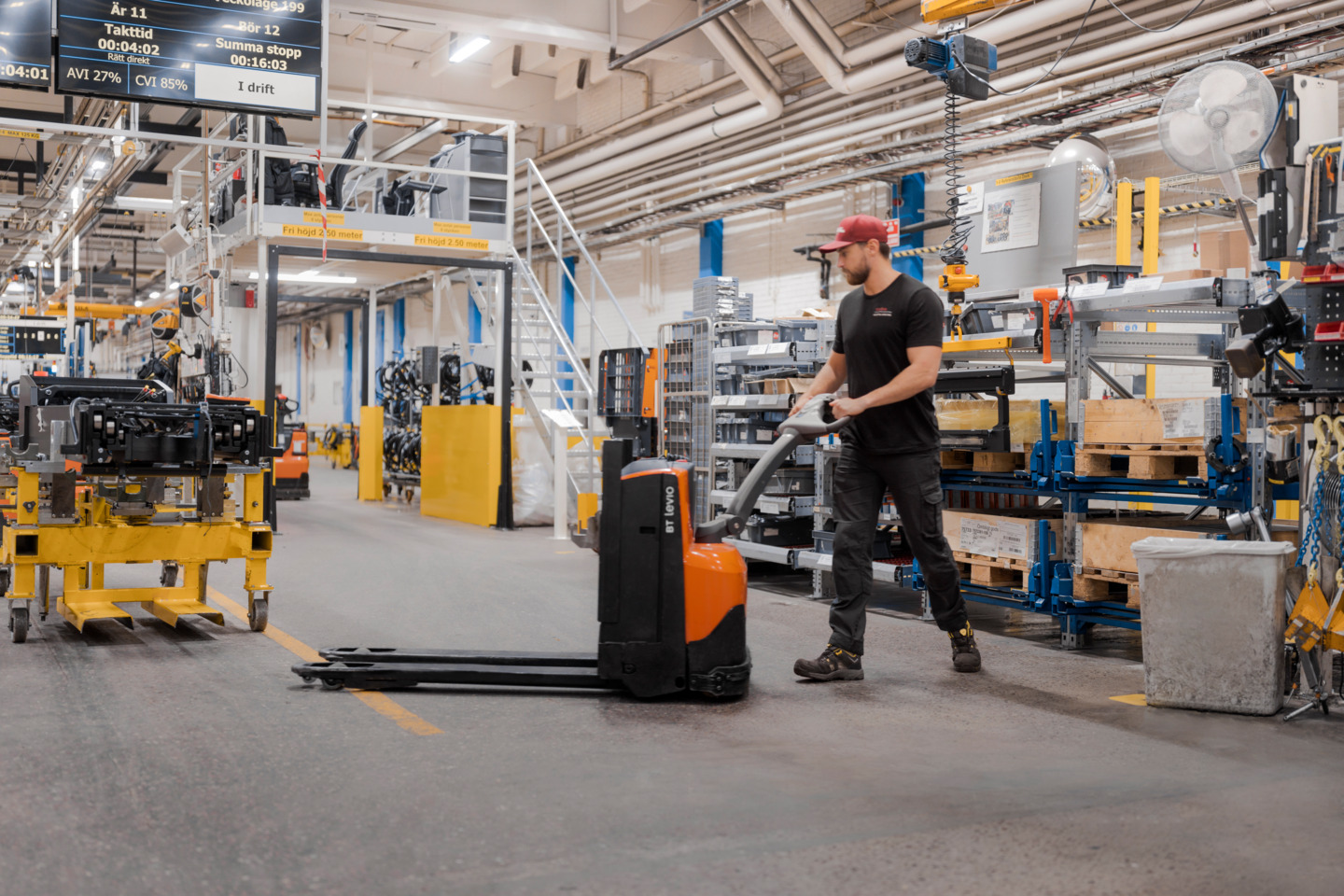
In warehouses and manufacturing facilities, the forklift is at the centre of daily operations. But as automation becomes more prevalent, many businesses are asking a critical question: should we stick with manual forklifts, or invest in Automated Guided Vehicles (AGVs)?
There’s no one-size-fits-all answer. It all depends on your operation’s scale, complexity, and long-term goals. In this blog post, we break it down for you:
What’s the difference?
Manual forklifts are operated by trained operators. They are flexible, relatively inexpensive upfront, and ideal for dynamic environments where tasks change frequently.
Automated Guided Vehicles (AGVs), on the other hand, are self-driving vehicles that follow predefined paths or use advanced navigation systems. They are designed for consistency, repetitive movements, and reduced human intervention.
Why AGVs?
AGVs tend to outperform manual forklifts in environments that are:
1. Highly repetitive: If your operation involves moving the same loads along the same routes all day, AGVs can do this with exceptional consistency.
2. High volume: The more you move, the more automation pays off. AGVs don’t tire, don’t take breaks, and can run 24/7.
3. Labour-constrained: If hiring and retaining forklift drivers is difficult or expensive, automation becomes an attractive option.
4. Safety conscious: AGVs reduce human error, which is a major cause of warehouse accidents. They follow strict rules and are equipped with sensors to avoid collisions.
Why manual forklifts?
Manual forklifts can remain the better choice in many situations:
6. Unpredictable workflows: If your layout, inventory, or processes change frequently, humans adapt faster than machines.
7. Low to moderate volume: If you don’t have enough throughput, the ROI on AGVs may take a while to materialise.
8. Tight budgets: Manual forklifts are cheaper upfront. AGVs require significant investment not just in vehicles, but also in infrastructure and integration.
9. Complex decision-making tasks: Humans still outperform automation in situations requiring judgment, improvisation, or multi-tasking.
10. Challenging environments: Manual forklifts are far more adaptable to more challenging environments. AGVs typically perform best on smooth, well-maintained indoor floors with predictable lighting and minimal debris.
In contrast, human-operated forklifts can handle:
- Outdoor environments exposed to weather
- Uneven or damaged surfaces
- Mixed indoor-outdoor transitions
- Changing conditions
The cost question: it’s not just upfront
A common mistake is comparing only purchase prices.
Manual forklifts:
- Lower upfront cost
- Ongoing labour costs (wages, training, turnover)
- Higher risk of accidents and damage
AGVs:
- High initial investment, however, rental options are available which can reduce this.
- Lower ongoing labour costs
- Maintenance, software, and integration expenses
- Potential productivity gains
The real question is: what does it cost you to move one pallet today and what could it cost in the future?
ROI: when does automation pay off?
Automation tends to make financial sense when:
- Labour costs are high or rising
- Operations run multiple shifts (or could benefit from 24/7 uptime)
- Processes are stable and predictable
- Throughput is high enough to justify the investment
In many cases, companies see ROI in 2–5 years but can start seeing savings in the first year.
Operational impact: beyond the numbers
Switching to AGVs isn’t just a financial decision, it’s an operational transformation.
You may need to:
- Standardise processes
- Redesign layouts
- Train staff to manage and maintain systems
- Integrate with warehouse management software
A hybrid approach
Some facilities don’t choose one or the other, they combine both.
For example: Use AGVs for long, repetitive transport routes but keep manual forklifts for flexible, ad hoc tasks.
This approach allows you to automate where it makes sense without losing adaptability.
Key questions to ask yourself:
- How repetitive are your material flows?
- What are your true labour costs (including turnover and training)?
- Is your layout stable enough for automation?
- What’s your expected growth over the next 3–5 years?
- Are safety incidents a significant issue?
If most of your answers point toward stability, scale, and cost pressure, AGVs are worth serious consideration.
Automation isn’t about replacing people; it’s about optimising systems. In the right environment, AGVs can unlock efficiency, safety, and scalability.