
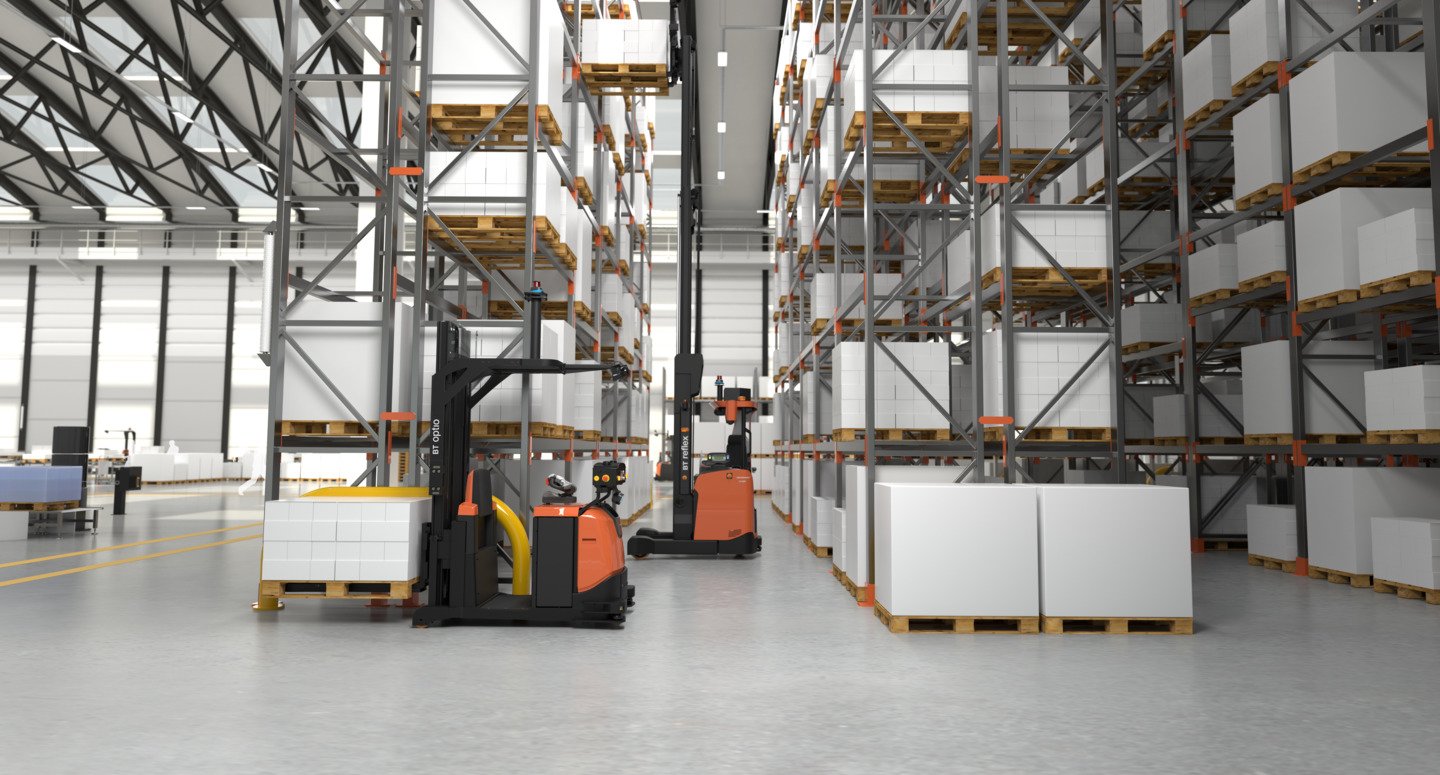
Automated guided vehicles (AGVs) can take on repetitive material handling tasks, helping businesses create more consistent flows, improve productivity and make better use of their workforce.
But AGV isn’t a one-size-fits-all solution.
From simple point-to-point pallet movements to replenishment, high-level storage and just-in-time delivery, different types of automated vehicles are designed for different tasks.
Understanding the options available – and where each one works best – is an important first step when considering automation.
What is an AGV?
An automated guided vehicle (AGV) is a driverless vehicle used to move goods and materials around warehouses, production facilities and distribution centres.
Rather than relying on an operator to complete every movement, AGVs follow defined routes and instructions to carry out repetitive transport and handling tasks automatically.
They can be introduced into individual material flows or form part of a wider automated system, making it possible to start with a specific process and scale automation as operational requirements develop.
So, what are the different types of AGV and what are they used for?
Automated pallet carriers
Automated pallet carriers are designed for straightforward horizontal pallet transport.
They provide fork-free movement of individual pallets and are particularly suited to repetitive A-to-B or loop transport where goods regularly need to travel between fixed locations.
For example, an automated pallet carrier could continuously transport pallets between production and a buffer area, taking a repetitive movement away from employees.
Best suited to:
- Point-to-point pallet transport
- Repetitive A-to-B movements
- Loop transport
- Connecting different areas or processes
- Simple, high-frequency material flows
Automated warehouse trucks
Some applications require more than horizontal transport. Automated warehouse trucks combine automated movement with the load-handling capabilities traditionally associated with warehouse equipment.
Depending on the application, they can transport pallets, handle block stacking, move loads into racking and support high-level storage.
This makes them suitable for automating a wider range of warehouse flows, including put-away, replenishment and finished goods movements.
They can also operate manually when required, providing additional flexibility within mixed operations.
Best suited to:
- Pallet transport
- Put-away
- Replenishment
- Block stacking
- Pallet handling
- High-level storage
Automated tow trains
In production and manufacturing environments, material often needs to be supplied to multiple locations at regular intervals.
Automated tow trains are designed for fork-free pallet and item handling and can transport multiple loads as part of a single movement.
They are particularly useful for just-in-time delivery and milk-run applications, where materials need to be supplied consistently to production or assembly areas.
Best suited to:
- Just-in-time material delivery
- Milk runs
- Production replenishment
- Transporting multiple loads
- Repetitive supply routes
Automated stackers
Automated stackers are well suited to applications where pallets need to be both transported and lifted.
They can collect loads from defined locations, move them through the operation and place them into floor locations or racking without the need for an operator to complete each movement.
This makes them particularly useful for repetitive flows such as moving pallets from production to storage, replenishing areas or transferring finished goods towards outbound.
Best suited to:
- Repetitive pallet movements
- Low and medium-level storage
- Floor-to-floor transport
- Production-to-storage flows
- Inbound and outbound handling
Automated reach trucks
Where storage height is an important part of the operation, automated reach trucks can extend automation into high-level racking.
Rather than limiting automation to horizontal pallet transport, automated reach trucks can move pallets between floor locations and storage positions at height.
This can make them particularly valuable in warehouses where repetitive put-away and retrieval tasks account for a significant amount of manual truck movement.
Best suited to:
- High-level pallet storage
- Put-away and retrieval
- Replenishment
- High-bay warehouse operations
- Repetitive racking movements
Shuttle-based storage solutions
Not every automated solution moves around the warehouse in the same way as a traditional AGV.
Shuttle systems are designed specifically for high-density storage, travelling within storage channels to move pallets efficiently through deep racking.
Toyota's semi-automated shuttle solutions can achieve high levels of space utilisation while increasing throughput, making them particularly useful where storage capacity is a priority. They can also be suited to demanding environments such as cold stores.
Best suited to:
- High-density pallet storage
- Deep-lane storage
- Maximising warehouse capacity
- High-throughput applications
- Cold store operations
Which AGV is right for your operation?
The right AGV depends less on the vehicle itself and more on the process you are trying to improve.
A good place to start is by looking for repetitive and predictable material flows within your operation.
Consider:
- What is being moved?
- Where is it moving from and to?
- How frequently is the journey repeated?
- Does the load need to be lifted or stored?
- What storage height is required?
- Is the movement currently dependent on manual labour?
- Are there predictable peaks or bottlenecks within the flow?
A simple A-to-B pallet movement may only require an automated pallet carrier, while a flow involving racking will require a vehicle capable of load handling. A manufacturing environment with regular line-side deliveries may be better suited to an automated tow train.
The aim isn't to automate for the sake of automation. It is to identify repetitive processes where automation can remove unnecessary movement, create a more consistent flow and add measurable value.
Start with the flow, not the technology
Introducing automation doesn't necessarily mean redesigning your entire warehouse or automating every process at once.
Toyota takes a step-by-step approach, identifying repetitive flows and looking at where automation can have the greatest operational impact.
By starting with a defined process, businesses can introduce automation at a manageable scale, prove its value and expand when the operation is ready.
Toyota's T-ONE automation software can then connect and coordinate AGVs with existing infrastructure and warehouse systems, helping different automated processes work together as the solution grows.
Take the next step in your automation journey
Every operation is different, and choosing the right automated solution starts with understanding your existing processes, challenges and goals.