
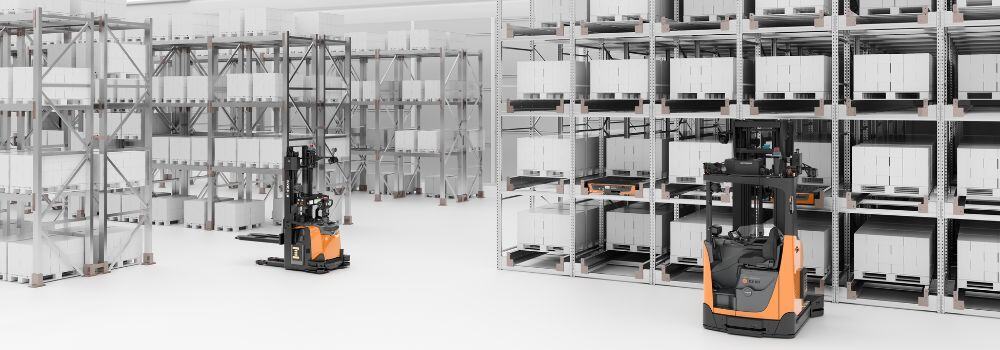
If you're asking, "should I automate my warehouse?", you're not alone. Labour shortages, rising operational costs, increasing customer expectations and growing pressure to improve productivity are driving more businesses to explore warehouse automation more than ever before.
But warehouse automation isn't just for large distribution centres or manufacturers. Today, businesses of all sizes are using automation to move products more efficiently, reduce waste, improve safety and create operations that can scale as demand grows.
This blog explains everything you need to know before investing in automation for your facility.
What is warehouse automation?
Warehouse automation is the use of technology to perform repetitive warehouse tasks with minimal human intervention.
Rather than relying entirely on manual processes, automation helps move, store and transport goods more efficiently using systems such as:
- Automated Guided Vehicles (AGVs)
- Autonomous Mobile Robots (AMRs)
- Conveyor systems
- Automated storage and retrieval systems (AS/RS)
While automation can cover many warehouse processes, material handling automation focuses specifically on moving goods safely and efficiently throughout your operation.
What processes can I automate in my warehouse?
Warehouse automation can be applied across almost every stage of your operation, from receiving goods through to dispatch. The most effective automation projects focus on repetitive, time-consuming and low-value tasks that slow down productivity or create unnecessary waste. By automating these processes, businesses can improve efficiency, increase accuracy, enhance safety and free employees to focus on work that adds greater value.
Common warehouse processes that can be automated include:
- Pallet transport
- Put-away and replenishment
- Storage and retrieval
- Inventory management
- Sorting and consolidation
- Loading and dispatch
Not every warehouse needs to automate every process. The best approach is to identify where bottlenecks, manual handling and operational waste have the greatest impact on productivity. Starting with these high-impact areas allows businesses to achieve measurable returns while creating a scalable foundation for future automation.
Why should I automate my warehouse?
There isn't one single reason businesses automate. It's usually a combination of operational challenges that automation helps solve.
1. Reduce operating costs
One of the biggest drivers for automation is reducing the cost of moving materials.
Manual transport involves:
- Labour costs
- Vehicle maintenance
- Product damage
- Inefficient travel routes
- Downtime
Automated vehicles optimise every journey, reducing unnecessary travel and helping lower the cost per pallet movement. Over time, these savings can provide a strong return on investment.
2. Improve productivity
Automated vehicles don't become distracted or vary their performance. They operate consistently throughout every shift, helping maintain predictable throughput and keeping material flowing across the facility.
Benefits include:
- Continuous operation (24 hours a day, 365 days a year if required)
- Consistent transport times
- Reduced bottlenecks
- Better production flow
- Faster replenishment
Instead of waiting for forklift availability, materials arrive exactly when they're needed.
3. Address labour shortages
Many businesses struggle to recruit experienced forklift operators. Warehouse automation reduces dependence on labour for repetitive transport tasks, allowing employees to focus on work that adds greater value.
4. Improve warehouse safety
Forklifts remain one of the leading causes of warehouse accidents.
Automated Guided Vehicles use multiple safety systems including:
- Laser scanners
- Safety sensors
- Obstacle detection
- Controlled travel speeds
- Predictable routes
By reducing manual vehicle movements, businesses can significantly lower the risk of collisions and improve overall warehouse safety. Automation also removes employees from repetitive transport tasks that can contribute to fatigue and human error.
5. Increase accuracy
Manual transport inevitably introduces variation. Automated systems perform each journey in the same way every time.
This improves:
- Delivery accuracy
- Inventory accuracy
- Production scheduling
- Material availability
- Process consistency
Consistent material flow often leads to more predictable production performance.
6. Support business growth
As order volumes increase, many warehouses reach a point where manual processes struggle to keep pace.
Automation enables operations to scale without increasing labour at the same rate.
This creates a more flexible operation capable of handling:
- Seasonal peaks
- New product lines
- Higher customer demand
- Extended operating hours
- Future expansion
7. Operate around the clock
Unlike manual operations, automated vehicles can operate 24 hours a day with planned charging or battery management.
This makes automation particularly valuable for businesses operating:
- Multiple shifts
- Overnight production
- High-volume manufacturing
- Continuous production environments
Could Automation Be the Next Step for Your Operation?